The Aztecs, also known as the Mexica, were a powerful and complex civilization that flourished in central Mexico from the 14th to the 16th centuries. Renowned for their impressive military prowess, sophisticated social structure, intricate religious beliefs, and remarkable engineering feats, the Aztecs left an indelible mark on Mesoamerican history. Their rise to power and eventual downfall offers a fascinating glimpse into a society that was both brilliant and brutal.
From Nomadic Tribe to an Empire:
The story of the Aztecs begins with their humble origins as a nomadic tribe, the Mexica, who migrated from a mythical homeland known as Aztlán. Facing numerous challenges and hardships, they eventually settled on a swampy island in Lake Texcoco around 1325 AD. According to legend, they were instructed by their god Huitzilopochtli to build their city where they saw an eagle perched on a cactus devouring a serpent. This vision marked the founding of Tenochtitlan, which would become the magnificent capital of the Aztec Empire.
Through strategic alliances, military conquest, and a keen political acumen, the Aztecs began to expand their influence. They formed the Triple Alliance with the city-states of Texcoco and Tlacopan, effectively solidifying their control over the Valley of Mexico. This alliance allowed them to conquer neighboring territories, demanding tribute in the form of goods, services, and even human sacrifices.
A Society of Hierarchy and Innovation:
Aztec society was highly structured, with a clear hierarchy based on social status. At the top was the Emperor, known as the Tlatoani, who held absolute power. Below him were nobles, priests, warriors, merchants, artisans, and farmers. The lowest rung of society was occupied by slaves, often prisoners of war or those who had fallen into debt.
While known for their martial strength, the Aztecs were also skilled engineers and innovators. They developed elaborate irrigation systems, built impressive causeways connecting Tenochtitlan to the mainland, and created artificial islands called chinampas, which allowed them to cultivate fertile land in the lake.
Religion: A Central Pillar of Aztec Life:
Religion permeated every aspect of Aztec life. They worshipped a vast pantheon of gods and goddesses, each with their own specific domains and responsibilities. Huitzilopochtli, the god of war and the sun, was particularly important, demanding regular offerings to ensure the sun’s continued journey across the sky.
Human sacrifice was a central component of Aztec religious practice. They believed that the gods needed nourishment to maintain cosmic balance, and human blood was considered the most precious offering. While the scale of human sacrifice is often debated, its significance in Aztec belief and ritual is undeniable.
Art and Culture: A Reflection of Their Worldview:
Aztec art and culture were rich and vibrant, reflecting their beliefs, values, and daily life. They produced intricate featherwork, elaborate pottery, and monumental stone sculptures. The famous Aztec Calendar Stone, for example, is a testament to their advanced understanding of astronomy and mathematics.
Poetry, music, and dance also played important roles in Aztec society. They created elaborate codices (books) filled with intricate glyphs that recorded their history, religious beliefs, and astronomical knowledge.
The Downfall of an Empire:
The Aztec Empire reached its zenith in the early 16th century, but its reign was short-lived. In 1519, the Spanish conquistador Hernán Cortés landed on the coast of Mexico with a small army. Exploiting internal divisions among the Aztec allies and armed with superior weaponry, Cortés marched on Tenochtitlan.
After a protracted siege, the city fell to the Spanish forces in 1521. The arrival of European diseases, such as smallpox, also decimated the Aztec population, contributing to their defeat. The fall of Tenochtitlan marked the end of the Aztec Empire and the beginning of Spanish colonial rule in Mexico.
Legacy of a Powerful Civilization:
Despite its relatively brief existence, the Aztec civilization left a lasting legacy. Their contributions to art, architecture, engineering, and culture continue to fascinate and inspire. Understanding the Aztecs provides valuable insights into the complexities of Mesoamerican history and the enduring impact of a powerful civilization that once dominated the Valley of Mexico. While their empire may be gone, the echoes of their achievements resonate through the ages, reminding us of their ingenuity, resilience, and enduring influence.
A Look into Aztec Architecture
Aztec architecture showcased a distinctive style, blending simplicity with elegance, boldness with power, and vibrant colors with symbolic elements. While imposing temples stand out as architectural masterpieces, the Aztec empire’s construction prowess extended far beyond these grand structures.
The Aztec Empire was forged through the alliance of three groups: the Mexicas, Acolhua, and Tepanecs. Their power base was located in the Valley of Mexico, with Tenochtitlan (Mexica) and Texcoco (Acolhua) serving as key urban centers.
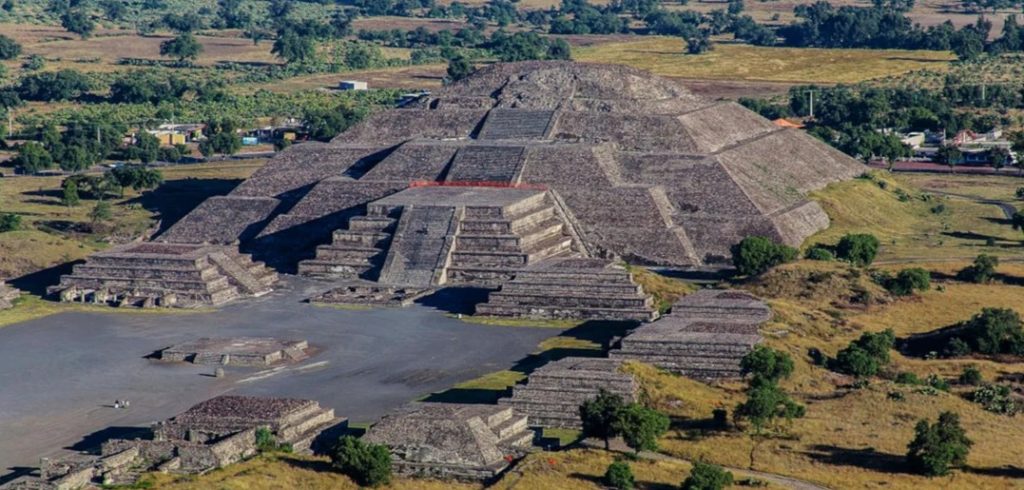
Tenochtitlan, the primary Aztec city, was erected atop an earlier Teotihuacan settlement. Founded around the 14th century, it flourished until the 16th century, becoming one of the world’s largest cities with a population reaching approximately 200,000.
The city’s layout revolved around a bustling central public square, encircled by temples, shrines, and pyramids. Further from the center, Aztec homes, courtyards, gardens, and agricultural lands were scattered throughout the outskirts.
Aztec architecture was deeply rooted in cosmology, astronomy, and religion. The diverse architectural styles found in their cities reflected these beliefs, offering valuable insights into their history, culture, and the impact of these elements on their buildings. Temples were a dominant architectural feature, exemplifying the Aztec devotion to their gods and the practice of sacrificial rituals.
The Toltec Influence
The Aztecs demonstrated exceptional building skills, constructing pyramids, ball courts, plazas, temples, and dwellings. Their architectural inspiration came largely from the Toltecs, a Mesoamerican civilization that thrived in central Mexico from around 900 to 1168 AD.
The Toltecs held a prominent position in Mesoamerican history, serving as a cultural benchmark for later societies. The Aztecs considered themselves successors to the Toltecs, admiring their artistic, architectural, craftsmanship, and cultural achievements.
Some historians have questioned whether Aztec society descended directly from the Toltecs. However, this type of suggestion has been made for other Mesoamerican civilizations, such as Teotihuacan. Despite these questions, the Aztecs adopted Nahuatl, the Toltec language. In Aztec society, the Nahuatl term for Toltec became synonymous with “artisan,” highlighting their perception of the Toltecs as the pinnacle of Mesoamerican culture, art, and design.
Aztec architecture is characterized by distinct styles employed in the construction of buildings and cities. Their architectural and artistic principles mirrored those of earlier Mesoamerican civilizations, including the use of grid systems in city planning and the construction of massive pyramid-shaped temples.
Pyramids held a central role in Aztec construction, with the Templo Mayor (Great Temple) in Tenochtitlan being a prime example of these structures.
Aztec Temples: Teocalli
Aztec temples, referred to as Teocalli (houses of the gods), served as places of worship, prayer, and offerings to maintain the strength and balance of the gods.
Identifying Aztec temples can sometimes be a challenge, as it is tempting to assume that large structures like pyramids were temples or palaces. However, existing knowledge provides a good understanding of religious areas and building appearances centuries ago.
Religious activities often took place in dedicated areas within cities. Certain monuments were devoted to specific gods, while others were erected for particular celebrations. The most prominent examples of Aztec religious architecture are the great pyramids. These stable, four-sided structures were designed to withstand earthquakes and featured staircases on one side, leading to a flat top often adorned with a sanctuary.
The Templo Mayor, a stepped pyramid with two sanctuaries at its summit, was located in the center of Tenochtitlan. Unfortunately, limited portions of the original pyramid remain, relying heavily on historical accounts, including those of Spanish conquistadors who witnessed it during the conquest of the Aztec Empire in 1521.
Much of the Templo Mayor and Tenochtitlan were destroyed by the Spanish, who erected their own city (present-day Mexico City) on the ruins of the Aztec capital.
The Templo Mayor observed by the Spanish conquistadors in 1521 represented the seventh and final iteration of the great temple since its initial construction in 1325. The most recent version of the Templo Mayor included various additions and modifications by successive Aztec leaders (Huey Tlatoani).
The ruins of the pyramid show that each addition to the temple was built over the previous structure.
Characteristics of Aztec Architecture
The final version of the Templo Mayor was built sometime in the late 15th century. It was a pyramid with four distinct levels or terraces and two sets of stairs leading to the upper platform that was 60 m tall.
This platform housed two sanctuaries dedicated to prominent Aztec gods. Spanish accounts describe the pyramid as being painted in bright colors and adorned with artistic reliefs of Aztec snakes and warriors.
A key feature of Aztec architecture was the practice of building upon existing structures, such as temples, rather than replacing them. This is evident in the archeological site of Templo Mayor.
Aztecs were also skilled craftsmen, working with stone to construct large and elaborate temples. Their architecture reflected their cultural beliefs, including religious practices, deities, and astronomical knowledge. Images of eagles, snakes, shells, and sea creatures frequently appeared which all symbolized different aspects of Aztec life.
Materials Used
The Aztecs utilized primitive tools, such as stones, chisels, and blades, to construct their buildings. They focused on building strong foundations due to the soil conditions and humid climate.
Tezontle, a colorful cut volcanic stone, formed the basis of their buildings. They also utilized local stones like rubble and limestone, which were often traded.
They decorated their buildings and materials with carvings that were unique and added texture to the structures. They also used local wood such as pine and oak wood from the forests for their beams and doors.
Aztec Houses
Unlike the grand stone temples, Aztec houses were constructed with interwoven wooden trunks and possibly mud bricks (adobe). The floors were typically made of earth or stone.
Roofs were typically made of interwoven sticks or thatches, leaves, and grass. Middle-class Aztec houses typically consisted of a single room where families slept and housed a shrine for religious homage.
The homes of the nobles, the pipiltin, were more elaborate, indicative of their wealth. These homes had ample space and contained more ornate works of art that reflected Aztec religion and customs.