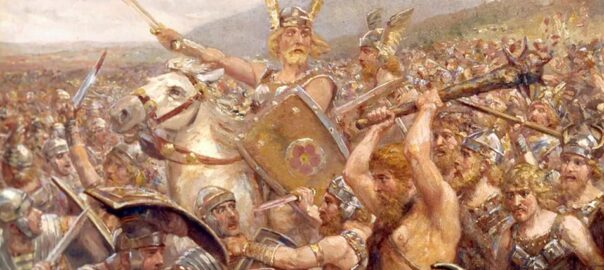
The Vikings were a seafaring Norse people from Scandinavia, primarily comprising present-day Denmark, Norway, and Sweden, who played a significant role in European history from the late 8th to the early 11th century, often referred to as the Viking Age. Renowned for their maritime prowess, the Vikings engaged in exploration, trade, raiding, and settlement across large swathes of Europe, reaching as far as North America and the Caspian Sea. Their iconic longships enabled them to navigate both the open ocean and shallow rivers, facilitating their adventures and the establishment of trade networks. Viking society was complex and diverse, featuring a rich tapestry of mythology, art, and culture, with a polytheistic belief system centered around gods like Odin and Thor. Despite their notorious reputation as ruthless raiders, Vikings also contributed to economic and cultural exchanges, significantly influencing the regions they encountered. The legacy of the Vikings persists today, celebrated in popular culture through literature, films, and television series, while ongoing archaeological discoveries continue to shed light on their impressive civilization.
The Vikings, who thrived during the Viking Age from approximately 793 to 1066 AD, were a complex society known for their exploration, trade, and warfare. Originating from Scandinavia, they ventured beyond their homelands, reaching as far as North America (notably Vinland), parts of the British Isles, and the Mediterranean. Their longships were technological marvels that facilitated swift travel and conquests. Beyond their reputation as fierce raiders, the Vikings established extensive trade networks and cultural exchanges, blending with local populations. Norse mythology and sagas reflect their rich cultural heritage, with gods such as Odin and Thor playing central roles. The legacy of the Vikings continues to influence modern culture, evidenced by their depictions in literature, film, and art, while archaeological finds have deepened our understanding of their way of life.

The primary themes surrounding the Vikings include exploration, conquest, and cultural exchange. Their voyages reflected a spirit of adventure and curiosity as they sought new lands and resources, leading to settlements and trade networks across Europe and beyond. Additionally, themes of bravery and heroism are prevalent in their sagas and myths, illustrating their valor in battle and connection to the gods. Norse mythology, with its rich pantheon and moral tales, also embodies themes of fate, honor, and the struggle between order and chaos. Furthermore, the Vikings’ dual identity as both raiders and traders highlights a complex interplay of violence and commerce, shaping their impact on the societies they encountered. Overall, the Viking narrative encompasses a blend of exploration, cultural synthesis, and the enduring human spirit of adventure.